- Equity Code :832537

A pulse-jet dust collector consists of several essential components that work together to filter particulate-laden air and periodically clean the filter media. The system typically includes a dirty-air inlet with a pre-separation zone, filter bags supported by cages, a tube sheet, a compressed-air manifold with pulse valves and blow pipes, a cleaning control system, and a hopper for dust discharge. Each component plays a specific role in ensuring efficient filtration, stable differential pressure, and reliable long-term operation.
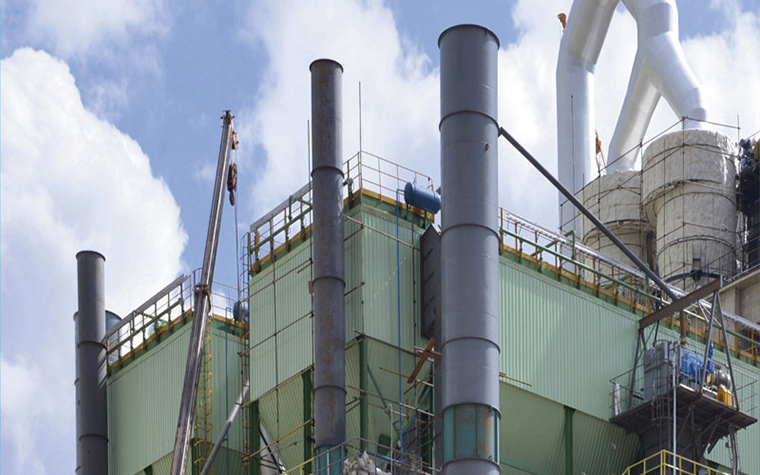
Dust-laden air enters the dust collector through a central inlet and is distributed to each compartment through a duct system. As the airflow slows down and changes direction, larger particles fall directly into the hopper due to inertia and gravity.
Finer dust particles follow the airflow upward into the filtration chamber. The air passes through the filter bags from outside to inside. Dust is captured on the outer surface of the bags, forming a dust cake, while clean air enters the inner side of the bags.
The cleaned air then flows into the clean-air plenum and exits through the outlet system with the help of a fan. Meanwhile, the collected dust in the hopper is discharged through unloading devices and conveyed to a storage silo for further handling.
As filtration continues, dust accumulates on the filter bags, causing the system resistance to increase. When the differential pressure reaches a preset value, the cleaning cycle is triggered.
First, the valve of one compartment closes to stop airflow through that section. Then, a pulse valve opens and releases a short burst of compressed air (typically 0.1–0.2 seconds) through the blow pipe into the filter bags.
This pulse of air also induces additional clean air from the plenum into the bags. As a result, the filter bags expand rapidly from top to bottom. When the expansion reaches its limit, the bag tension creates a reverse acceleration, causing a quick vibration.
This sudden expansion and vibration loosen the dust cake on the outer surface of the bags, and the dust falls into the hopper.
After a short settling time, the compartment returns to filtration mode, and the next compartment enters the cleaning cycle. This sequence repeats continuously, allowing stable operation.
The cleaning process is controlled by a PLC system. It can operate in manual or automatic mode.
| Cleaning Method | Dust Removal Principles | Characteristics |
|---|---|---|
| Pulse-Jet Cleaning | A short, high-pressure burst of compressed air expands the filter bag rapidly. The sudden expansion creates a quick shock that detaches the dust cake from the bag surface. | Fast cleaning action; high-energy pulse; air-induced bag expansion; no mechanical movement. |
| Reverse-Air Cleaning | A large volume of low-pressure air flows in the reverse direction, causing the bags to gently collapse and release the dust cake. | Slow, low-pressure airflow; gentle cleaning; relies on reverse airflow rather than shock force. |
| Shaker Cleaning | The system uses mechanical shaking to vibrate the bags. Dust is removed through physical movement and gravity. | Mechanical vibration; low-energy cleaning; dependent on shaker mechanism and bag movement. |