- Equity Code :832537

Every manufacturing environment generates airborne particulate. Grinding, cutting, welding, mixing, conveying — each process releases dust that ranges from harmless nuisance to genuine industrial hazard. Left unmanaged, that particulate accumulates in machinery, degrades air quality, triggers regulatory penalties, and puts workers at risk.
Industrial dust collectors are engineered systems that capture, filter, and contain this airborne material at the point of generation — before it becomes a facility-wide problem. Think of them as the lungs of a production floor: constantly working in the background, quietly making everything else possible.
At its core, a dust collector pulls contaminated air from the work environment, passes it through one or more filtration stages, and returns clean air — either back into the facility or exhausted outside. The difference between a basic dust collector and a high-performance system lies in how efficiently it handles that middle step.
Modern units combine airflow engineering with precision-manufactured filter media. Contaminated air enters at controlled velocity; as it passes through filter elements, particulate is captured while clean air continues through. When filter resistance builds up, automatic pulse-jet cleaning systems dislodge accumulated dust into a collection hopper — extending filter life and maintaining consistent performance without stopping production.
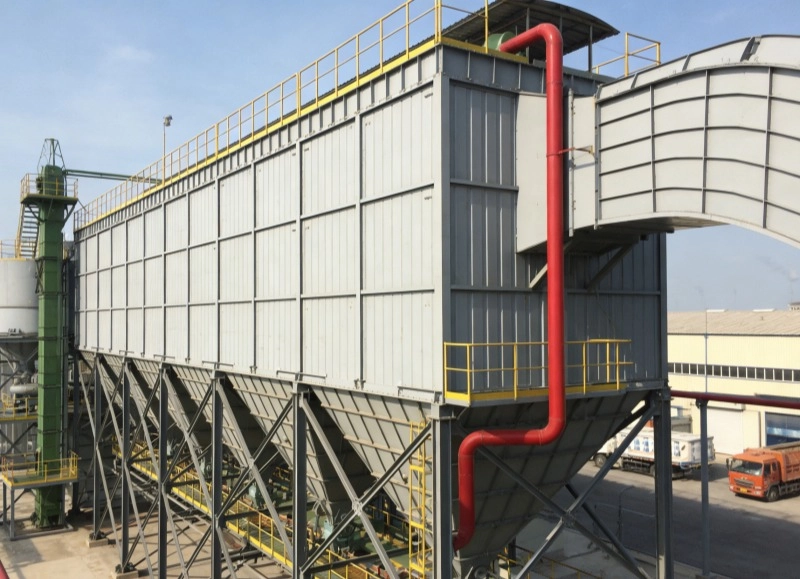
There is no universal dust collector. The right system depends on your dust characteristics, volume requirements, and facility constraints. Here are the five core technologies:
When evaluating or specifying a dust collection system, these are the parameters that actually drive performance decisions:
| Parameter | What it means | Why it matters |
|---|---|---|
| Airflow capacity (CFM / m³/h) | Volume of air the system can process per unit time | Must match or exceed total extraction demand across all collection points |
| Filtration efficiency (%) | Percentage of particulate captured vs. passing through | Regulatory compliance and worker safety targets define the minimum threshold |
| Filter rating (µm) | Smallest particle size the filter reliably captures | Finer dusts (silica, carbon black) require tighter-rated media |
| Pressure drop (Pa / in. H₂O) | Resistance across the filter system | Directly affects fan motor energy consumption and operating cost |
| Air-to-cloth ratio | Airflow per unit of filter media surface area | Determines filter life, cleaning frequency, and long-term maintenance cost |
| Inlet temperature (°C / °F) | Maximum temperature of incoming dusty air | High-temp processes require heat-rated media and housing materials |
Industrial dust collectors appear wherever particulate is generated at process scale. The specific requirements — dust type, concentration, temperature, moisture content — vary dramatically, which is why system selection always begins with a thorough characterisation of the source material.
Dust collection is not a one-size-fits-all commodity. The right system is engineered to the specific dust profile, airflow demand, facility layout, and emission compliance requirement of each installation. Procurement teams that understand this distinction make significantly better long-term capital decisions.
A structured selection process reduces risk and ensures the system you procure will perform across its full service life — not just at commissioning.
A dust collector in poor condition is not merely less efficient — it is a regulatory and safety liability. Most jurisdictions require documented evidence of ongoing performance monitoring, filter integrity testing, and emission measurement at defined intervals.
Proactive maintenance — regular differential pressure monitoring, scheduled filter inspections, pulse-jet valve testing, and hopper discharge audits — extends equipment service life and protects the emission compliance record that your operating permits depend on. The best systems are designed with service accessibility as a first-order engineering constraint, not an afterthought.
For procurement professionals, this means evaluating not just the system specification, but the manufacturer's documentation support, spare parts availability, and service network — because what you procure today will be maintained by your team for the next 15 to 20 years.